WMPA celebrates 50 years of service
March 31, 2026 in News
By Logan Dailey, WMPA Board Member
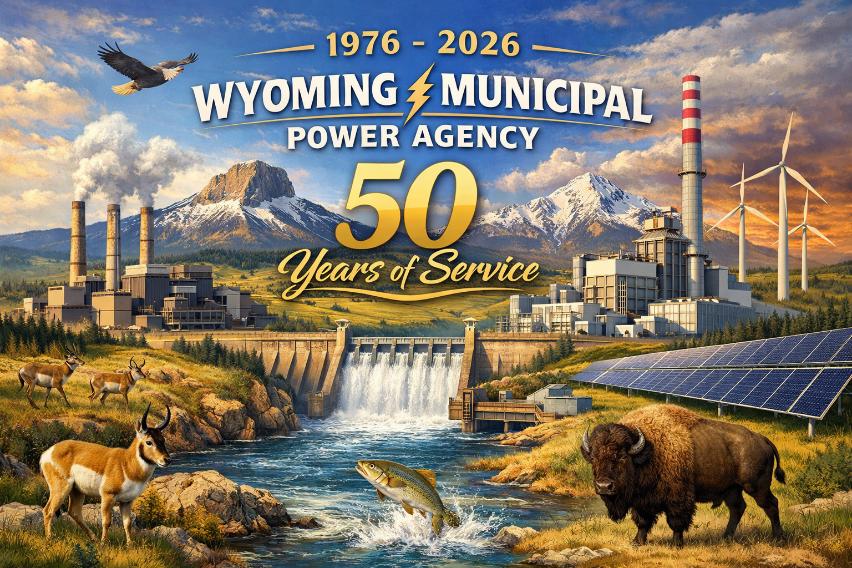
LUSK, Wyo. – The Wyoming Municipal Power Agency (WMPA) is celebrating 50 years of service to its members and the many residents and guests of the state of Wyoming. The agency was formally established February 1, 1976, by the signing of a Joint Powers Agreement between member communities. As of 2026, WMPA members include the municipalities of Cody, Fort Laramie, Guernsey, Lingle, Lusk, Pine Bluffs, Powell and Wheatland.
Rosemary Henry has worked for the agency for over 28 years and currently serves as the organization’s executive director. Henry is dedicated to working with member communities, her staff and the board of directors to ensure all WMPA members have an economic, long-term, reliable and environmentally responsible electric power supply.
“We ensure that all our communities receive the quantity of electricity that they want, when they want it and at the best price we can set, consistent with modern business practices,” Henry explained.
In addition to the active members of WMPA, the agency hosts several associate members. These members are Basin, Deaver, Gillette and Torrington. Though these entities do not receive power from WMPA, they are represented by WMPA through public relations and legislative efforts.
“There are 12 public power entities in the state of Wyoming,” she explained. “Though there are times where we take the same position on legislative issues that could impact those communities, our primary effort is to educate legislators about our industry.”
In addition to educating legislators, Henry and the WMPA staff work diligently to educate the public about all aspects of energy generation, transmission and distribution.
“The biggest misunderstanding of the general public is that different generation types are interchangeable,” she said. “The reality is that all the generation sources out there have different physic characteristics, emissions characteristics and costs.”
Providing the exact amount of electricity that people want when they want it, is the biggest challenge to reliable electricity. Most electricity is generated when customers want it. This means that enough generators must be available and ready to increase their output exactly when people want to use electricity. Not all generators can increase their output based on human needs.
The output of wind turbines and solar farms increase their output based on the weather rather than the whims of humans. Gas, hydroelectric, coal and nuclear can increase their output according to the whims of humans. The industry calls this attribute “dispatchability,” which is key to reliable electricity.
Solar and wind farms do not produce emissions once they are constructed. Gas and coal produce emissions. Adding batteries or hydroelectric pumped storage facilities to wind and solar farms adds the dispatchability attribute to the low emissions of wind and solar, but at a very high financial cost. Nuclear is dispatchable and avoids carbon emissions, but it is expensive. Hydroelectric facilities are dispatchable and have low emissions, but as these facilities must balance irrigation, fish, wildlife, recreation and other interests they typically limit dispatchability.
Over the course of Henry’s career, she has noticed a profound shift in the industry. Previously, customers were only concerned about the cost. Today, many people are taking a deeper look at the industry and are not only concerned about the cost of electricity, but also the environmental impact of energy generation. Henry describes the electric industry as an “industry of trade-offs; we balance reliability, emissions and cost.” Finding the right balance between reliability, emissions and cost is a challenge. The WMPA board and staff are committed to doing this for their customers.
“The most significant change is the interest that people have in the generation resources,” Henry explained. “When I began in the industry, it was primarily engineers and accountants who argued over what types of resources to build. Engineers focused on redundancy and reliability, while accountants worried about costs. Those were the two primary forces at work.”
Now, engineers and accountants are not the only concerned parties.
“Political policy and the public preference for types of generation have a much bigger role than they did before,” she added.
With the added pressure of political policy and public preference for the type of energy generation resources, WMPA and the energy industry, as a whole, have to shift their focus to ensure that customers receive the power they need through the means they desire and the means that are permitted by law. Though the industry is continuously evolving, WMPA is collaborating with members, industry partners and the public to find and enact energy solutions which will satisfy the public’s needs and preferences while maintaining reliability and affordability of electrical power.
For anyone interested in learning more about WMPA or the energy industry, please contact WMPA by visiting their office at 4041 U.S. Highway 20 in Lusk, calling 307-334-2170 or visiting WMPA.org.